


WASHINGTON —
“A group of Chinese nationals with ties to foreign criminal organizations crossed the southern border and infiltrated rural Oklahoma. They were joined by workers lured by false promises of good jobs in the United States. Upon arrival in Oklahoma, the Chinese nationals made the local residents an offer they couldn’t refuse: they promised to use their time and identities to purchase a nearby plot of land for hundreds of thousands of dollars. In return, the residents would receive an unconditional share of the profits. The deal was quick and easy. Within days, the newly acquired land was transformed into a large-scale illegal marijuana grow.”
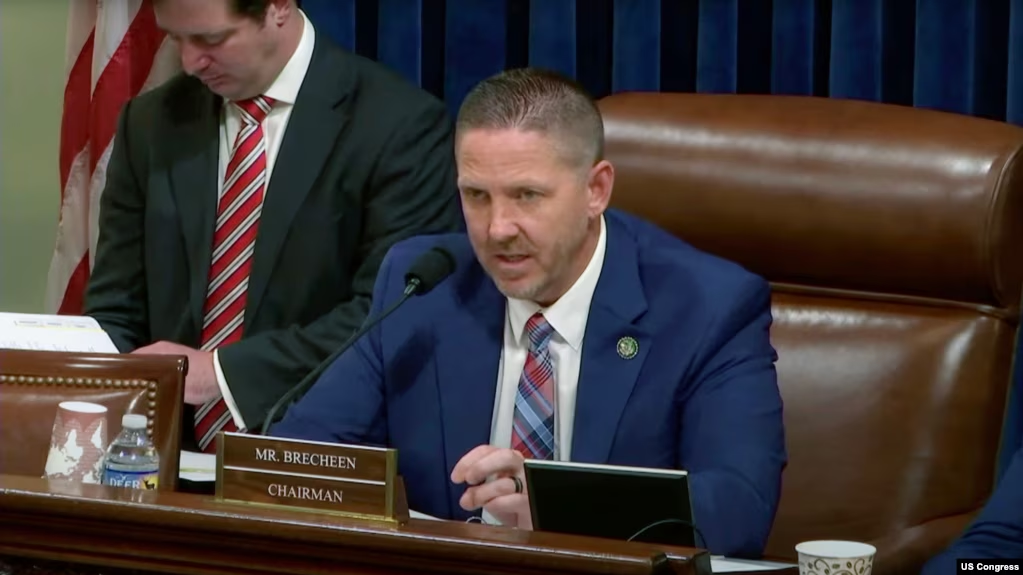
The U.S. House Homeland Security Committee’s Oversight, Investigations, and Accountability Subcommittee held a hearing on Thursday (September 18) titled “Invading the U.S. Homeland: How China Uses Illegal Gateways to Establish Criminal Networks in the United States .” In his opening remarks, Rep. Josh Brecheen, a Republican from Oklahoma and chairman of the subcommittee, described how Chinese citizens obtained land in the United States for illegal marijuana cultivation.
He went on to describe the operations of these illegal marijuana farms, saying workers there are forced to work 14-hour days under the watchful eyes of armed guards, confined to cramped living quarters with minimal running water and air conditioning, and using pesticides banned in the United States.
“Hundreds of pounds of illegally contaminated marijuana were then produced and ended up in the hands of people all over the United States, from Oklahoma to New York,” he said.
Brechin said the infiltration of Chinese criminal networks into Oklahoma is just the tip of the iceberg, a network that spans the entire U.S. Furthermore, these illegal cultivations have led to wider crime.
“Many illegal Chinese grow operations serve as fronts for broader criminal enterprises, including human trafficking, drug trafficking, prostitution, weapons smuggling, and money laundering. While the examples I highlighted occurred in our home state of Oklahoma, similar patterns are emerging in other states, including Maine, Massachusetts, and California. In fact, there are thousands of these grow sites scattered throughout our nation, including on tribal lands and in national parks.”
Shri Thanedar of Michigan, ranking member of the Oversight, Investigations, and Accountability Subcommittee, mentioned illegal marijuana cultivation by Chinese citizens in Michigan during his testimony at the hearing. In early July, four Chinese citizens were arrested for growing $5 million worth of marijuana in northern Michigan.
Tanidar said billions of dollars in illegal marijuana revenues help fund China’s Belt and Road Initiative, which competes with the United States for global influence.
Donnie Anderson, director of the Oklahoma Bureau of Narcotics and Dangerous Drugs, said at the hearing that he believed the Chinese government had expressed interest in Oklahoma’s marijuana industry. “We have documented the transfer of funds to Chinese banks and connections to Chinese government-controlled companies,” he said.
He noted that many illegal marijuana farms are even located near critical infrastructure, including military bases and important pipelines.
The man, who has 34 years of experience in public security and drug law enforcement, said he believes the CCP has access to these illegal grow sites given its cyber espionage activities and secret police stations set up among Chinese Americans.
Christopher Urben, a former DEA agent and executive, said he witnessed firsthand the growing presence of Chinese transnational criminal organizations in the United States during his 24-year career. In the last five years of his career, he became particularly focused on Chinese money laundering networks because of the harm they posed to the U.S. financial system.
“The Chinese money laundering network launders funds for numerous criminal organizations, including: Chinese suppliers of precursor chemicals needed for fentanyl production in Mexico; Mexican drug cartels that manufacture fentanyl and other drugs for sale in the United States; human trafficking networks; global operations to corrupt government authorities; wildlife traffickers; and black market marijuana growers and distributors in the United States from Mexico and other countries.”
Rep. Brechin, chairman of the House Oversight, Investigations, and Accountability Subcommittee, said the criminal network must be eradicated from American soil. He said: “The potential threat to our homeland posed by a fully operational criminal network colluding with a top foreign adversary cannot be ignored.”
The issue of illegal marijuana cultivation linked to China is gaining increasing attention among U.S. lawmakers.
In 2024, Senator Chuck Grassley, Republican of Iowa, said there has been a surge in illegal marijuana activity in the United States linked to China. He also said that thousands of licensed medical marijuana businesses in Oklahoma “have been flagged over the past year for suspicious activity that has ties to China.”
Maine Republican Senator Susan Collins has also repeatedly expressed concerns to federal officials at hearings about marijuana grow houses in Maine with ties to China.